


PPC Conversion Rate and What Good Looks Like
Advertising. Published November 11, 2026. Updated November 12, 2026.
A PPC conversion rate is the share of ad clicks that turn into a lead, call or sale. If 100 people click your ad and 6 fill out your form, your conversion rate is 6%.
What counts as good depends on your industry, your offer and what you call a conversion. A rate that's great for a B2B software company might be weak for an emergency plumber. The most useful target comes from your own numbers. National averages are a rough guide at best.
What a PPC conversion rate is and how it's calculated
To calculate it, divide conversions by clicks and multiply by 100. The number only means something once you define a conversion. A call, a form and a purchase each tell a different story.
Conversion rate vs click-through rate
People mix these two up often. They measure different steps.
Click-through rate is the share of people who saw your ad and clicked it. It tells you whether the ad earns attention.
Conversion rate is the share of people who clicked and then took action. It tells you whether the page and offer close the deal.
A strong click-through rate with a weak conversion rate points to the landing page or the offer. The ad works, but the page loses people.
A weak click-through rate with a strong conversion rate points to the ad. The page works, but too few people see a reason to click.
Fix the weaker step first. Raising both is the goal, but one usually lags.
What counts as a conversion
The number only means something if you know what you're counting. Every account sets its own conversion actions.
A lead form submitted.
A phone call from the ad or the website.
A booked appointment.
A purchase.
A quote request.
A chat started.
A signup for a newsletter, webinar or free trial.
These aren't equal. A newsletter signup is easy and brings little revenue. A booked job is harder to win and can bring in a full job's revenue.
Mixing them inflates your rate. Some accounts count page scrolls, video views and newsletter signups as conversions. They can show a high rate while bringing in few customers.
Set your main conversion as the action that leads to revenue. Track lighter actions as secondary goals so they don't skew the number.
Why conversion rates differ by industry and platform
Conversion rates swing by industry because buyers act differently. Someone with a burst pipe calls fast. Someone choosing a lawyer compares for days. Search ads usually convert better than social ads, since the searcher already wants something.
You'll find many published averages for PPC conversion rates. They rarely agree. Each study uses different accounts, conversion types and time periods.
The bigger lesson is why rates differ. Five forces explain most of the gap between industries.
Urgency
Urgent needs convert fast. A homeowner with a burst pipe calls the first credible plumber they find. Someone browsing patio furniture may visit five sites first.
Price
Lower prices convert more easily. A $40 product can sell on the first visit. A $40,000 kitchen remodel needs trust, research and a site visit.
Sales cycle
Short cycles convert in one session. Long cycles convert over weeks. B2B buyers often click several ads and read several pages before they reach out.
Type of conversion
Easy conversions push rates up. A free quote form converts better than a purchase. A call converts better than a long application.
Competition
Crowded markets give searchers more choices. When ten companies show up, each one gets a smaller share of conversions.
Search vs social conversion rates
Searchers and scrollers are in different moments. That shows in their conversion rates.
Search ads reach people who are looking right now. They typed a question or a service. Intent is high, so conversion rates are often higher.
Social ads reach people while they scroll. Most weren't looking for you. Intent is lower, so conversion rates are often lower.
That doesn't make social ads worse. They can reach more people at a lower cost per click. They also build demand that search ads catch later.
Compare channels by cost per customer. A lower conversion rate can still win when clicks cost half as much.
Conversion rates across ad platforms
Google Ads isn't the only PPC platform. Microsoft Advertising, Facebook, Instagram and LinkedIn all report conversion rates too.
Each platform counts a little differently. Some count views as well as clicks. Some use different windows for counting conversions.
That makes side-by-side comparisons tricky. A platform that counts view-through conversions can look better on paper.
Use one shared count when you compare. Your analytics or CRM can count leads by source with the same rules for every channel.
Then compare cost per customer across platforms. That number holds up even when each platform reports its own way.
PPC conversion rates by industry type
Use industry ranges as a rough starting point. Your own numbers matter more. The sample businesses below show how one rate can mean very different results. Price and margin make the difference.
The table below shows how common business types tend to compare. It describes patterns rather than promised numbers. Your own data beats any average.
| Business type | Typical main conversion | Why rates tend to be higher or lower |
|---|---|---|
| Emergency home services | Phone call | High urgency and a simple next step push rates up |
| Planned home projects | Quote or estimate request | Higher prices and comparison shopping pull rates down |
| Legal services | Consultation call or form | Strong intent, but searchers often contact several offices |
| Healthcare and dental | Appointment request | Clear need, but insurance and timing questions add friction |
| Ecommerce | Purchase | Rates vary by price point, shipping costs and checkout ease |
| B2B services | Demo or consultation request | Long sales cycles and several decision makers pull rates down |
| Software and SaaS | Free trial or demo | Free trials convert well, paid signups convert less often |
| Education and training | Inquiry or application | Long decisions and big commitments slow conversion |
| Real estate | Inquiry or showing request | Many browsers, few ready buyers at any moment |
| Local retail and restaurants | Directions, call or order | Simple actions and nearby intent help rates |
Use this as a guide to what affects your rate. Then measure your own baseline and improve from there.
Three sample businesses
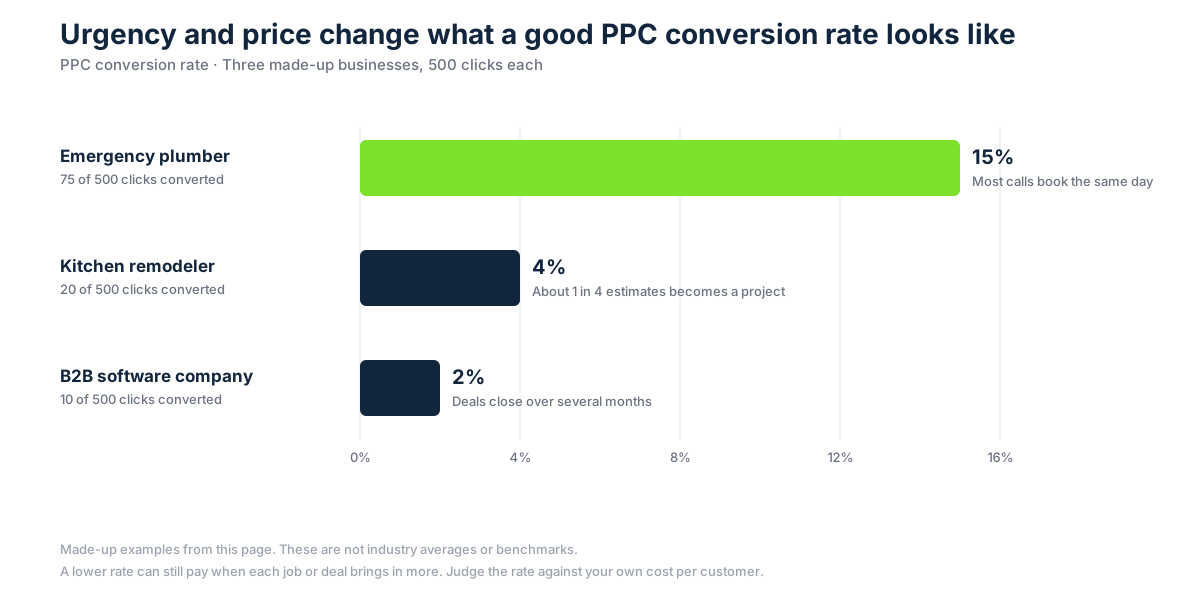
These businesses are invented. They show how the same conversion rate can mean very different things.
Example data.
An emergency plumber
The plumber runs search ads for burst pipes and water heater failures. The main conversion is a phone call.
Out of 500 clicks a month, 75 people call. That's a 15% conversion rate. Most calls book a job the same day.
A high rate fits this business. Searchers are in a hurry and want help now. A drop below 10% would be a warning sign to check right away.
A kitchen remodeler
The remodeler runs search ads for kitchen remodels. The main conversion is an estimate request.
Out of 500 clicks, 20 people request an estimate. That's a 4% conversion rate. About one in four estimates turns into a project.
A lower rate is normal here. Projects cost tens of thousands of dollars, and buyers compare several companies. Each signed job is large enough to cover the cost of many clicks.
A B2B software company
The company runs ads for its scheduling software. The main conversion is a demo request.
Out of 500 clicks, 10 people book a demo. That's a 2% conversion rate. Deals close over several months.
This rate can still pay off. Each new customer brings years of revenue. The company tracks pipeline and closed deals to judge results.
The lesson is simple. Compare your rate with your own past results and your profit math. A rate that looks low next to a plumber can be healthy for your business.
Reading the rate without fooling yourself
High conversion rates can hide bad leads. Low ones can hide big sales. Read the rate next to cost per lead and booked revenue. Give a campaign enough clicks before you judge it, or you'll react to noise.
Why your conversion rate alone can mislead you
A high conversion rate feels good. It doesn't always mean the campaign works.
A rate can rise while sales fall. That happens when cheap, easy conversions crowd out real ones.
A rate can fall while profit rises. That happens when you cut low-quality traffic and focus on buyers with bigger jobs.
So pair conversion rate with three other numbers.
Cost per conversion. What you pay for each lead or sale.
Lead quality. How many leads become customers.
Revenue per conversion. What each lead or sale brings in.
Together, they show whether the campaign makes money. Conversion rate alone can't.
How to read conversion rate in Google Ads
Google Ads shows several conversion columns. Knowing which one to read saves confusion.
The Conversions column counts your main conversion actions. These are the actions set to guide bidding.
The All conversions column adds secondary actions. It's often much higher and can make results look better than they are.
The Conv. rate column divides conversions by interactions. Use it alongside cost per conversion.
Check your conversion window too. It's the number of days after a click that a conversion still counts. A long window catches slow buyers. A short window can miss them.
Some conversions show up days after the click. Recent days often look worse than they'll end up. Give the data a week to fill in before you judge it.
How long before you can judge the rate
Conversion rates need enough data to be useful. A handful of clicks can swing wildly.
Wait for a steady volume of clicks before you draw conclusions. For many small accounts, that means at least a few weeks.
Watch for seasonality. A landscaper's rate in April won't match November. Compare the same months year over year when you can.
Look at trends over weeks. A bad Tuesday tells you little. A slide over a month tells you a lot.
How to set your own target conversion rate
Set your target from your own math. Start with what a customer is worth and what you can pay for a lead. Then work back to the conversion rate that makes the ads profitable. Adjust it for season and device.
The best target starts with your business math. Work back from what a customer brings in.
Step 1: Know your numbers
Find your average job or order value. Find your close rate, the share of leads that become customers.
Step 2: Pick a target cost per customer
Decide how much you can spend to win one customer and still earn the profit you want.
Step 3: Work back to cost per lead
Multiply your target cost per customer by your close rate. That's the most you can pay per lead.
Step 4: Work back to conversion rate
Divide your average cost per click by your target cost per lead. Multiply by 100. That's the conversion rate you need to hit your target.
A worked example
These numbers are made up for illustration.
A roofing company earns $1,500 profit on an average repair. The owner will spend up to $300 to win one job.
The team closes one of every three leads. That caps each lead at $100.
Clicks cost about $8 on average. $8 divided by $100 is 0.08. The campaign needs an 8% conversion rate to hit target.
If the real rate is 5%, each lead costs $160. The owner can raise the rate, lower click costs or improve the close rate.
Plug in your own numbers the same way. It gives you a target that fits your business.
Seasonality and conversion rates
Conversion rates move with the seasons in many industries. Plan for it so you don't panic over normal swings.
HVAC rates often rise during the first heat wave and the first cold snap. Landscaping rates peak in spring. Tax preparers peak before filing deadlines.
Slow months can drop your rate even when nothing is broken. Fewer people are ready to buy.
Compare each month with the same month last year when you have the data. That shows whether a change is real or seasonal.
Adjust budgets with the season. Spend more when buyers are ready and pull back when they aren't.
Conversion rates on mobile vs desktop
Mobile and desktop users act differently. Your rates may differ too.
Mobile users often want to call. Strong call options can lift mobile results.
Desktop users often research longer. They may fill out a detailed form or come back later.
Check your conversion rate by device in Google Ads. If mobile lags, look at page speed, form length and tap-to-call buttons first.
You can adjust bids by device when one clearly converts better. Base that choice on cost per customer.
What hurts a PPC conversion rate
Most low rates trace back to a mismatch. The ad promises one thing and the page shows another. Slow pages, weak offers and broad keywords drag the rate down too. Quality Score suffers along with it.
Most low conversion rates trace back to a few causes. Check these first.
The wrong traffic
Broad keywords and loose match types pull in people who will never buy. "Plumber salary" and "how to fix a toilet myself" don't bring customers.
Check your search terms report every week. Add irrelevant phrases as negative keywords.
A mismatch between ad and page
The ad promises one thing, and the page talks about another. People who don't find what they clicked for leave.
Send each ad group to a page that matches its keywords and offer.
Slow pages
Mobile users leave slow pages fast. Every extra second of load time costs you visitors.
Compress images, cut heavy scripts and test pages on a phone.
Long or confusing forms
Every field you add is a reason to quit. Ask only for what you need to follow up.
Name, phone, email and a short message cover most service businesses.
No clear next step
If people can't tell what to do, they leave. One main action works better than five competing buttons.
Missing trust signals
People want proof before they reach out. Reviews, licenses, guarantees and photos of real work all help.
Hidden phone numbers
Many local buyers want to call. If the number is buried or isn't tap-to-call on mobile, calls drop.
How Quality Score ties in
Quality Score is Google's rating of how relevant your keywords, ads and landing pages are. It doesn't use your conversion rate directly.
It does share the same building blocks. Ads that match the search tend to earn better scores. Pages that deliver on the ad tend to convert better too.
Better scores can lower what you pay per click. Lower click costs and higher conversion rates together cut your cost per lead from both sides.
Look at the landing page experience part of Quality Score. A below-average rating there often points to the same problems that hurt conversions.
How to improve your PPC conversion rate
Improve your PPC conversion rate by fixing the page before you touch bids. Match the headline to the search. Make the phone number easy to tap. Then test one change at a time, and follow up on every lead fast.
Small changes often add up. Work through these in order.
Tighten your keywords
Focus on searches with buying intent. Words like "near me," "cost," "repair," "hire" and "service" tend to signal a buyer.
Pause keywords that spend money with no conversions after a fair run.
Write ads that match intent
Use the searcher's words in your headline. Add a reason to choose you and a clear next step.
Our Google Ads examples show patterns that work for local and B2B ads.
Build focused landing pages
A page built for one service and one offer usually converts better than a home page. Repeat the ad's promise near the top.
Our landing page service builds pages for each ad group.
Add call options
Use call assets in your ads and a tap-to-call number on the page. Track calls as conversions.
Shorten forms
Cut fields you don't use. Test a two-step form if you need more details. A short first step gets people started.
Show proof near the action
Put reviews, ratings and guarantees close to your form or call button. That's where doubt peaks.
Make an offer
A free estimate, a seasonal discount or a fast booking slot gives people a reason to act today.
Test one change at a time
Change the headline, the offer or the form, then measure. Testing several changes at once hides what worked.
Answer leads fast
This one doesn't change your rate in the ad platform. It changes your real results. Leads that hear back in minutes book more often. A lead left waiting a day often calls someone else.
Phone calls need special attention
For many local businesses, calls bring most of the revenue. They're also the easiest conversion to miss.
Calls from ads can be tracked when someone taps your number in the ad. Google Ads can count calls that last longer than a set time.
Calls from your website need a different setup. A tracking number on the page ties each call back to the click.
Short calls rarely mean a lead. Set a minimum call length so wrong numbers and hang-ups don't count.
Listen to a sample of calls each month. You'll learn which keywords bring real buyers and how your team handles them.
A missed call is a lost conversion. If calls go to voicemail during business hours, your real conversion rate is lower than the report shows.
Landing page tests that often lift conversions
The page itself holds most of the gains for many accounts. These tests are a good place to start.
Headline match. Make the headline repeat the keyword and offer from the ad.
Above-the-fold action. Put the form or call button where people see it without scrolling.
Form length. Test a three-field form against your current one.
Offer framing. Test "Free estimate" against "Get a price in 24 hours" or a seasonal discount.
Proof placement. Move reviews and ratings right next to the form.
Photos. Test real photos of your team and work against stock images.
Page speed. Cut a heavy slider or video and see whether more people stay.
Run one test at a time and give it enough traffic to show a clear result. Keep the winner and test the next idea against it.
What happens after the conversion
The ad platform stops counting at the form or call. Your business keeps going.
Track what happens next. Count the leads that answered your follow-up, the ones that booked and the ones that paid.
This lead-to-customer rate often matters more than the ad conversion rate. A campaign with a lower rate but better leads can bring more revenue.
Speed is a big part of it. Leads cool off fast, so a quick call back raises the share that books.
Your process matters too. A clear script, a fast quote and a simple booking step help turn leads into jobs.
Feed those results back into Google Ads when you can. Imported offline conversions show the system which clicks became customers.

Track conversions the right way
Bad tracking makes every number wrong. Count real leads only, and import offline sales when you can. Smart bidding learns from the conversions you report. Feed it junk and it will find more junk.
Get tracking right before you judge any campaign.
Set up conversion tracking in Google Ads for forms, calls and purchases.
Track calls from ads and calls from your website. Call tracking numbers can tie each call to the right campaign.
Use one main conversion for bidding. Mark lighter actions as secondary so they don't steer the bidding.
Check for double counting. A form that fires twice or a thank-you page that loads twice can inflate your rate.
Import offline results when you can. Telling Google which leads became customers helps it find more buyers like them.
Test every conversion after setup. Submit a test form and make a test call, then confirm they show up.
Conversion rate and bidding strategy
Google's automated bidding uses your conversion data to set bids. The quality of that data shapes your results.
Strategies that aim for conversions need steady conversion volume. Thin data can make results swing.
If you count low-value actions, the system will chase them. It will find people who download a guide instead of people who book a job.
Value-based bidding can help businesses with jobs of different sizes. You assign values to conversions, and the system aims for more total value.
Whatever strategy you use, give it clean data and time to learn. Frequent big changes reset that learning.
A checklist and when to get help
Run this checklist before you change budgets. If the rate stays low after the basics are fixed, a fresh set of eyes can help. A short audit often finds the gap.
A PPC conversion rate checklist
Use this list for a quick review of any campaign.
Your main conversion is an action that leads to revenue.
Secondary actions are marked so they don't guide bidding.
Every form and call is tested and showing up in reports.
Search terms are reviewed weekly, with negatives added.
Each ad group sends people to a matching landing page.
Pages load fast on a phone.
Forms ask only for what you need.
Your phone number is tap-to-call on mobile.
Reviews and guarantees sit near the form or button.
Leads hear back within minutes during business hours.
You judge results by cost per customer along with conversion rate.
If you can't check off most of these, start with the gaps. They usually hold the biggest gains.
When to get help
Many owners manage their own PPC well. Others hit a ceiling.
Steady spend with few leads is one sign you may need help. A rate that won't move and tracking you don't trust are others.
Good help starts with an audit of your tracking, keywords, ads and landing pages. Most gains come from fixing basics.
Our PPC management service covers tracking, campaign builds, landing pages and reporting. For site-wide conversion work, see our conversion rate optimization service.
To check your own rate, use our conversion rate calculator.
Common questions
What is a good PPC conversion rate?
The one that hits your target cost per customer. Work it out from your job value, close rate and click costs.
Is a 2% conversion rate bad?
Your prices and margins decide it. A 2% rate on high-value B2B deals can be profitable. The same rate on low-cost jobs may lose money.
Do calls count as conversions?
They should if calls bring you business. Track calls from ads and from your site so you see the full picture.
Why did my conversion rate drop suddenly?
Common causes include broken tracking, a site change, new competitors or seasonal shifts. Check tracking first.
Should I count form starts as conversions?
No. Count completed forms. Form starts can be a secondary signal for fixing the page.
Can a conversion rate be too high?
Yes, if tracking double counts. A sudden jump often means a tag fires twice or counts page views as leads.
Should I judge conversion rate by keyword?
Yes, once a keyword has enough clicks. Low-rate keywords with real spend are the first to cut or fix.
Do Performance Max campaigns report conversion rate the same way?
The formula is the same, but traffic comes from many channels. Compare it with search campaigns carefully.
Does chat count as a conversion?
It can, if chats turn into leads. Count only chats that leave contact details.