


How to Calculate Marketing ROI
Websites and tracking. Published November 10, 2026. Updated November 10, 2026.

To calculate marketing ROI, subtract your marketing cost from the gross profit it produced. Divide that by the marketing cost, then multiply by 100. If $5,000 of marketing brings in $15,000 of gross profit, your ROI is 200%. Use gross profit, since revenue hides the cost of delivering the work.
The formula is simple. Getting honest inputs is the hard part.

What is marketing ROI?
Marketing ROI, or return on marketing investment, measures how much profit your marketing produced for each dollar spent. A positive ROI means the marketing paid for itself and then some. A negative ROI means it cost more than it earned.
Owners use it to answer three questions. Does marketing pay for itself? Which channel deserves more budget? And which one should be cut?
ROI works at every level. You can measure one ad campaign, one channel like SEO or your whole marketing budget for the year. The math stays the same.
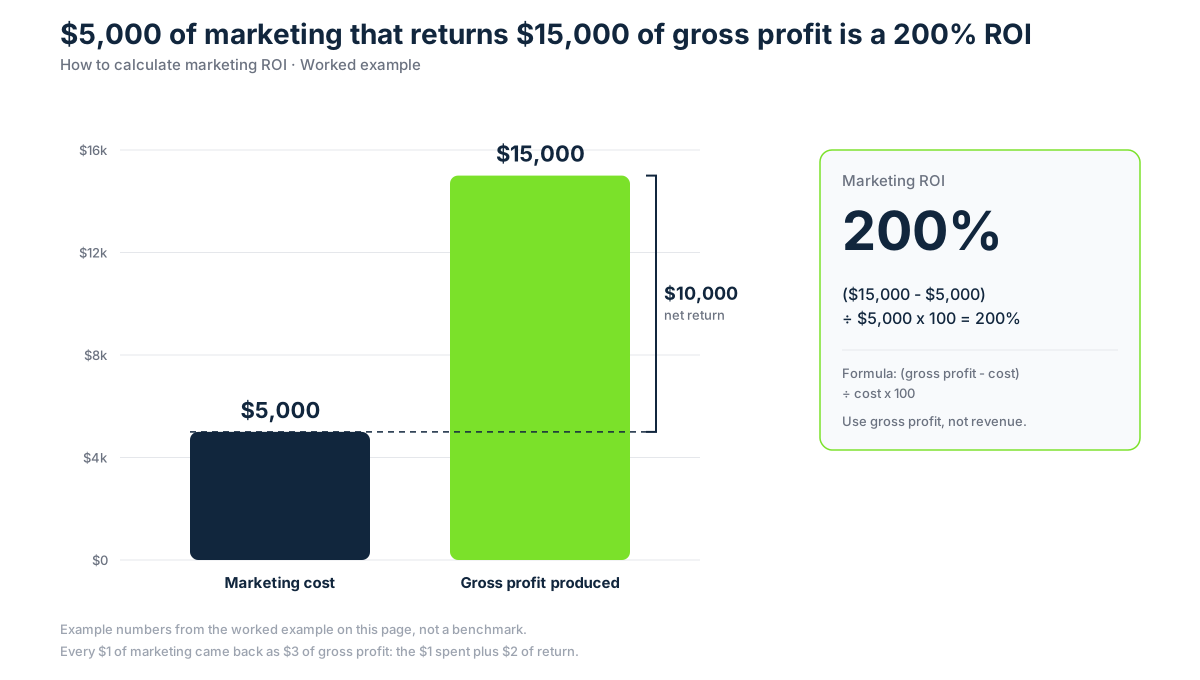
How to calculate marketing ROI with the right formula
The standard formula uses revenue:
Marketing ROI = (Revenue from marketing − Marketing cost) ÷ Marketing cost × 100
That version is quick, but it flatters your results. It treats every dollar of revenue as profit. A better version uses gross profit:
Marketing ROI = (Gross profit from marketing − Marketing cost) ÷ Marketing cost × 100
Gross profit is revenue minus the direct cost of delivering the sale. For a service business, that's labor, materials and parts. For a store, it's the cost of the goods.
Take a sample business. A remodeling company spends $8,000 on marketing in a month. That marketing brings in $40,000 of jobs. Materials and labor on those jobs cost $24,000, so gross profit is $16,000.
The revenue formula says ROI is 400%. The gross profit formula says 100%. Both use the same campaign. The second number tells the truth about what landed in the bank.
How do you calculate ROI before leads turn into sales?
Many deals take weeks or months to close. You still need to judge a campaign before every lead decides. The lead value method handles that.
Use these steps. The numbers are an example only.
- Count the leads from the campaign. Say 60 calls and forms.
- Apply your close rate. If you close 25%, expect 15 new customers.
- Multiply by average gross profit per sale. At $1,200 profit each, that's $18,000.
- Subtract the campaign cost. If it cost $6,000, net return is $12,000.
- Divide by cost and multiply by 100. ROI is 200%.
Use your real close rate from the last six to twelve months. If you don't track it, start now. A close rate pulled from thin air makes the whole calculation guesswork.
Revisit the number once the deals close. If actual results differ from the estimate, adjust the close rate you use next time.
How does lifetime value change marketing ROI?
A first sale is often only part of what a customer is worth. Repeat jobs, renewals, service plans and referrals add up.
Picture a heating and cooling company. A new customer's first repair brings $300 of gross profit. Over the next five years, the average customer adds a maintenance plan and one more repair. That brings lifetime gross profit to $1,500. These figures are made up.
If the company judges a $3,000 campaign on first sales alone, 10 new customers produce $3,000 of profit. ROI looks like zero. On lifetime value, those same 10 customers are worth $15,000. ROI is 400%.
Both views are useful. First-sale ROI tells you about cash flow this month. Lifetime ROI tells you whether the channel builds the business. Track both, especially for businesses with repeat customers.
How are ROI, ROAS, CAC and LTV different?
These four numbers get mixed up often. Each answers a different question.
| Metric | What it measures | Formula | Best use |
|---|---|---|---|
| Marketing ROI | Profit returned per dollar of marketing | (Gross profit − marketing cost) ÷ marketing cost | Judging whether marketing pays overall |
| ROAS | Revenue per dollar of ad spend | Revenue from ads ÷ ad spend | Tuning ad campaigns quickly |
| CAC | Cost to win one new customer | Total sales and marketing cost ÷ new customers | Comparing channels and setting budgets |
| LTV | Profit from a customer over the whole relationship | Average gross profit per customer over time | Deciding how much you can pay to win a customer |
ROAS leaves out agency fees, staff time and profit margin, so a "good" ROAS can still lose money. CAC and LTV work best together. When lifetime value runs well above acquisition cost, you can afford to grow faster.
Which costs belong in a marketing ROI calculation?
Leaving out costs is the most common way ROI gets inflated. Count everything it took to produce the result:
- Ad spend on every platform.
- Agency, consultant or freelancer fees.
- Staff time spent on marketing, at a fair hourly cost.
- Software, such as CRM, email, call tracking and SEO tools.
- Creative costs, like photos, video, design and printing.
- Lead costs, such as fees paid to lead sellers or directories.
- Promotions and discounts given to win the sale.
Staff time is the line most people skip. If your office manager spends ten hours a week on social media, that's a real cost. Leaving it out makes social look free.
What is a good marketing ROI?
A good ROI is any ROI above your break-even point that beats your other options. There's no single number that fits every business, because profit margins vary so much.
Break-even depends on your gross margin. Divide 1 by your margin to find the revenue you need per marketing dollar just to cover costs.
| Gross margin | Revenue needed per $1 of marketing to break even |
|---|---|
| 20% | $5.00 |
| 30% | $3.33 |
| 40% | $2.50 |
| 50% | $2.00 |
| 60% | $1.67 |
| 70% | $1.43 |
A store with 20% margins needs $5 in sales for every $1 of marketing just to break even. A service business with 60% margins needs $1.67. That's why copying a "good ROAS" from another industry can lead you astray.
Above break-even, compare channels against each other. Say SEO returns 300% and paid social returns 50%. Budget should lean toward SEO, as long as SEO can absorb more spend.
Comparing ROI across channels
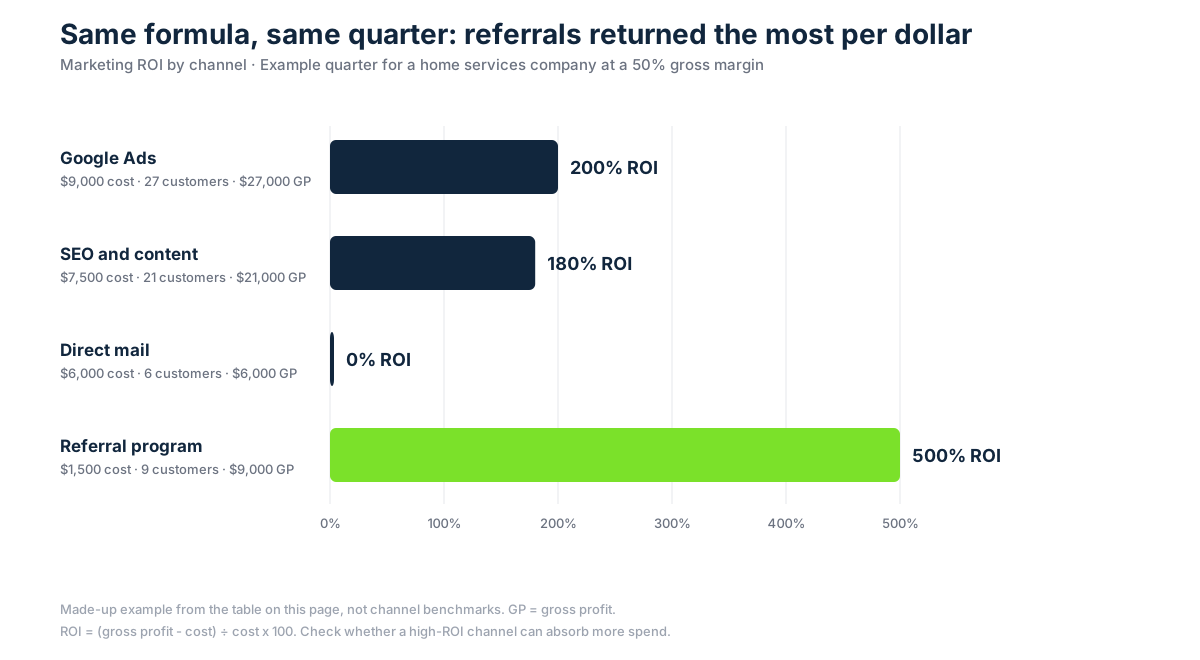
Run the same formula on each channel for the same period. Then line them up. The table shows a sample quarter for a home services company with a 50% gross margin.
| Channel | Cost for the quarter | Leads | New customers | Gross profit | ROI |
|---|---|---|---|---|---|
| Google Ads | $9,000 | 90 | 27 | $27,000 | 200% |
| SEO and content | $7,500 | 60 | 21 | $21,000 | 180% |
| Direct mail | $6,000 | 25 | 6 | $6,000 | 0% |
| Referral program | $1,500 | 15 | 9 | $9,000 | 500% |
A few things jump out. The referral program costs the least and returns the most. It can only grow as fast as happy customers send friends, though. Google Ads and SEO both earn well and could take more budget. Direct mail only breaks even. It might deserve a new offer or a new list before it gets cut.
Notice the close rates, too. Referrals closed 60% of leads, while direct mail closed 24%. Warm leads close better, so lead count alone can mislead you about a channel.
Channels also feed each other. Mail and ads can push people to search your name, and SEO gets the credit. Look at totals as well as individual channels before you make big cuts.
Why is marketing ROI hard to measure?
A few problems show up again and again.
Credit is the first. A customer might see a billboard, search your name, click an ad and call. Which channel earned the sale? Marketing attribution assigns credit using call tracking, form tracking and CRM data.
Time is the second. SEO and content often lose money for months before they pay. Judge them too early and you'll cut the channel that would have paid most.
Phone calls are the third. For many service businesses, most leads call. Without call tracking, those leads look like they came from nowhere.
Brand is the fourth. Some marketing makes every other channel work better without getting direct credit. Trucks with your logo, sponsorships and reviews all fall here.
Track what you can, note what you can't and look at trends over several months. A rough ROI beats no ROI.
A worked example over two quarters
Take a sample HVAC company that spends $6,000 on search ads over two quarters. The ads bring in 60 leads. Twenty of them book jobs worth $45,000 in total.
At first glance, that looks like a strong return. Then the owner subtracts the cost of the work itself. Equipment, labor and permits come to $30,000. That leaves $15,000 in gross profit from the ads.
The real ROI is ($15,000 minus $6,000) divided by $6,000. That's 150%. It's still good, just far lower than the revenue number suggested.
Then the owner looks one step further. Eight of those customers signed maintenance plans. Each plan adds profit every year the customer stays. Over three years, the return on those same ads keeps climbing.
Run the same math for every channel, using the same time window. Then compare them side by side before you move any budget.
Repeat the review each quarter as new data comes in.
What mistakes throw off marketing ROI?
Knowing how to calculate marketing ROI is only half the job. The other half is avoiding the errors that skew the number. These errors are common, and each one leads to a bad budget call.
Using revenue instead of profit inflates every result. Leaving out fees and staff time makes cheap-looking channels seem better than they are. Judging long-term channels after one month kills them early.
Counting leads as sales is another. A lead that never closes adds no profit. Tie leads to closed deals in your CRM.
Mixing time frames causes trouble too. Spend from March and sales from June can belong together. Match them on purpose.
Finally, don't chase one perfect number. A clear, consistent method you use every month beats a complex model nobody updates.
To run your own numbers, try our marketing ROI calculator. You'll find more guides on our marketing insights page.
Common questions
What is the simplest way to calculate marketing ROI?
Subtract marketing cost from the gross profit it produced, divide by the marketing cost and multiply by 100. Use gross profit rather than revenue for an honest number.
Is a 100% marketing ROI good?
A 100% ROI means you doubled your money after covering the cost of the work. For most businesses that's a healthy result. Compare it with your other channels before moving budget.
How often should I calculate marketing ROI?
Check ad channels monthly. Review SEO, content and brand work quarterly, since they take longer to pay. Do a full-year review when you set next year's budget.
Can marketing ROI be negative and still pay off?
Sometimes. A new channel or a new location may lose money at first while it builds. Set a time limit and a target, and cut the channel if it doesn't get there.
How do I calculate ROI for SEO?
Track leads and sales from organic search, using call tracking and your CRM. Add up all SEO costs over the same period, including content and staff time. Then run the gross profit formula over six to twelve months.
What's the difference between marketing ROI and ROAS?
ROAS divides revenue by ad spend only. Marketing ROI uses profit and counts every marketing cost. ROAS is quicker for tuning ads. ROI tells you whether the business made money.