


SEO Goals and Marketing KPIs
SEO and AI search. Published November 11, 2026. Updated November 12, 2026.
SEO goals that tie organic search to booked work, plus the marketing KPIs that show where the funnel leaks. Includes a worked funnel from impressions to customers.
SEO goals are the outcomes you want from organic search. They're written so an owner can tell whether the work paid for itself. Marketing KPIs are the small set of numbers that show whether any channel is moving those outcomes. This page puts both in one place. A ranking goal with no lead goal is how a report gets busy while the schedule stays empty.
If you want the measurement companion, start with how to measure website traffic. The numbers still have to attach to jobs you can deliver.
What a useful SEO goal looks like
An SEO goal names four things.
- Who the search is for. Emergency replacement in one metro is a different goal from a planned remodel in three states.
- What they should do. Call, form, book or request a bid.
- The number, and the date. "More leads" is a wish. "40 qualified organic leads a month by June" is a goal.
- The business result those leads have to support. Booked work, at a margin that pays for the time.
Traffic and rankings are how you get there. They're weak as the goal itself. A page can rank and still send the wrong job. A site can gain sessions from a definition article and never hear from a buyer.
Write goals an operator can check without a specialist in the room.
- Qualified organic leads per month, with "qualified" defined in one sentence.
- Organic leads that became booked jobs, and the gross profit on those jobs.
- Rankings and click-through for the terms that match the work you want. Skip every other term the site happens to rank for.
- For local businesses, the Business Profile actions that match a real inquiry, like calls and direction requests. Count them beside site leads so you don't double them.
A technical target can sit under the goal. Faster pages, indexable service pages and clean titles help the goal. They can't replace it. If the only movement in a quarter is a crawl report, the SEO goal wasn't about the business yet. The work of earning those visits is SEO services. Google's SEO Starter Guide is the public reference for how search engines expect a site to be built.
Leading measures and lagging results
Lagging results are what the owner feels. Booked jobs, collected revenue, gross profit. They arrive late. A service business may rank better in March and book the work in May.
Leading measures move earlier. Impressions for the money terms, click-through from the search result, landing-page conversion, speed to the first reply. You watch the leading measures so you aren't waiting a quarter to learn the page is wrong.
Harvard Business School Online's article on marketing KPIs makes the same point. Measuring only the final outcome hides the step where people got stuck. SEO goals need both layers. The goal is the lagging result you promised. The KPIs are the leading counts that tell you which step to fix this week.
Marketing KPIs and ordinary metrics
A metric is anything you can count. Sessions, pages per visit, followers, email opens, time on page. A marketing KPI is a metric you picked because a change in it should change a decision.
Most teams drown in metrics and starve for KPIs. The test is simple. Say the number moved. If you wouldn't change the page, the bid, the offer or the follow-up, it isn't a KPI for you. It can stay in a folder. It doesn't belong on the one page the owner reads.
Calling a number vanity is about decisions, not morals. Impressions are a real awareness KPI when you're trying to be seen for a new service. They're vanity when you already know the leak is the form and you keep reporting reach anyway.
KPI and metric, side by side
| Metric | Marketing KPI | |
|---|---|---|
| What it is | Any count the tools will give you | A count you chose because it should change a decision |
| How many | As many as the software collects | A handful, tied to one goal |
| Example | Pages per session, followers, email opens | Qualified leads, acquisition cost, booked jobs from organic |
| Failure mode | The report gets longer and the decision doesn't | You picked a number that can't move the business result |
A metric becomes a KPI when you attach a baseline, a target and a decision. "Organic sessions" is a metric. "Organic sessions on the water-heater page, with a lead-rate target, reviewed every Monday" is a KPI inside an SEO goal. The same count can be either one. It depends on whether anyone will act.
One funnel, from impressions to customers
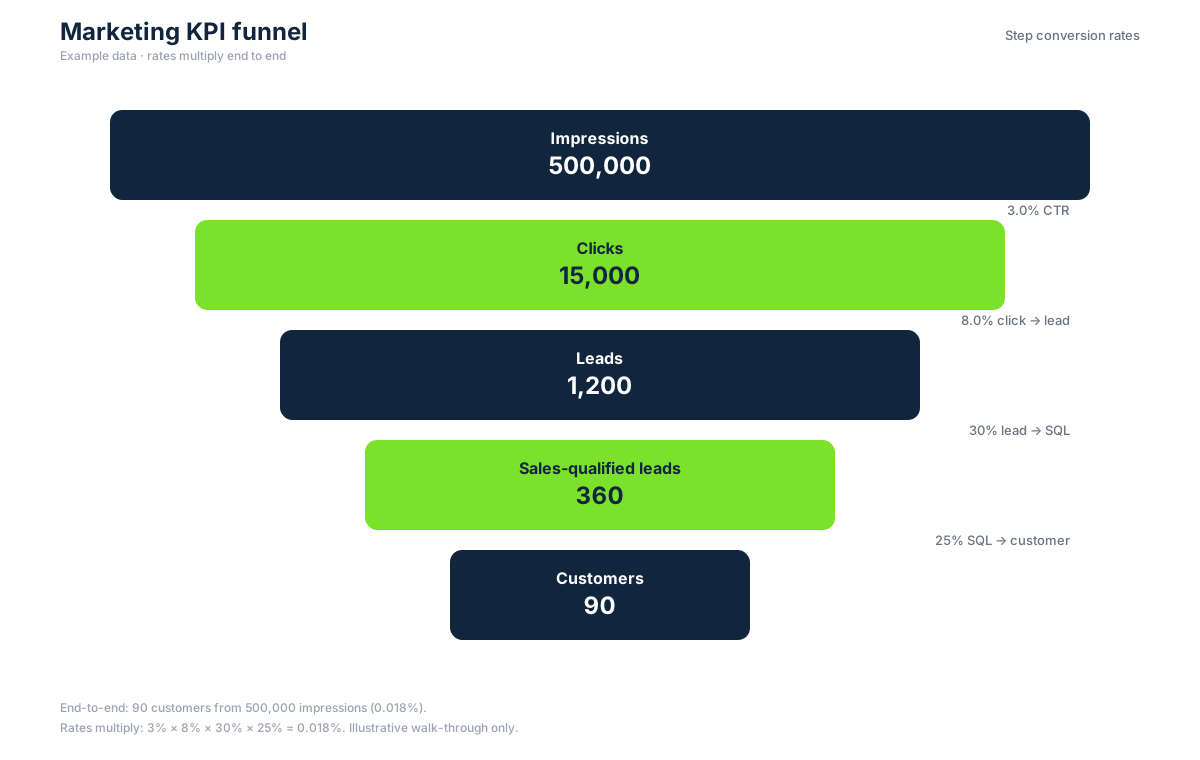
Example data.
The figure is one connected example, and the rates multiply. It's illustrative walk-through data, not a benchmark for your trade.
Example
Check the arithmetic before you trust a funnel in any tool.
- Click-through rate = 15,000 / 500,000 = 3 percent.
- Click to lead = 1,200 / 15,000 = 8 percent.
- Lead to sales-qualified lead = 360 / 1,200 = 30 percent.
- Sales-qualified lead to customer = 90 / 360 = 25 percent.
- End to end = 90 / 500,000 = 0.018 percent.
And 0.03 × 0.08 × 0.30 × 0.25 = 0.00018, which is 0.018 percent. If a dashboard's end-to-end rate doesn't equal the product of the steps, the steps aren't counting the same people.
How to read it
Start at the step that lost the most people compared with what you expected. Don't start at the biggest raw drop. Impressions to clicks will always drop the most in raw count, since most people who see a listing don't click. A 3 percent click-through can be fine while an 8 percent lead rate is the problem. That happens when the page doesn't match the promise.
Sales-qualified, in this example, means a lead a person would actually want to call. Define it for your shop. A form that says "just browsing" is a lead. It may not be qualified. Skip that step and divide customers by all leads, and you'll blame the close rate. Some of those leads were never real.
Ninety customers from half a million impressions can be a strong result or a weak one. You can't know until you attach revenue and cost. That's why this funnel hands off to what is ROAS and what is customer acquisition cost. Volume without those two numbers is a tour of the funnel, not a decision.
Five KPIs to start with
You don't need thirty KPIs. These five cover the questions an owner asks on Monday. They line up with the funnel.
- Impressions or visits. Did the right people have a chance to see you? For paid, use impressions. For SEO goals, use Search Console impressions and clicks on the queries that match paid work. Add sessions if you need the on-site view.
- Click-through rate. Of the people who saw you, how many chose you? CTR = clicks / impressions. In the example, 3 percent.
- Leads. Calls, forms and chats you can count. Click-to-lead rate = leads / clicks. In the example, 8 percent.
- Cost per lead, then acquisition cost. Spend / leads, then spend plus sales cost / new customers. Cost tells you whether the volume is affordable. The funnel chart has no dollars, so don't invent a cost for it.
- Customers, or booked jobs. The count of people who bought, and the gross profit on that work. SQL-to-customer rate in the example is 25 percent.
Add return on investment when the question is profit. A simple version is profit from the marketing-sourced work, divided by the cost of winning it. How to calculate marketing ROI is the longer pass. The marketing ROI calculator is the quick arithmetic.
Only room for three numbers on a wall? Use qualified leads, acquisition cost and gross profit from new customers. Keep the earlier steps in the working report so you can see the leak.
Examples of marketing KPIs by stage
Stages are a map, not a law. A person can call from a first impression. The labels still help you pick KPIs.
Awareness
Impressions. The number of times the ad, the listing or the post was shown. One person can add several impressions. Reach is the count of people, not the count of shows. Don't swap the words. A climb in impressions with flat reach means the same people saw you more often.
Search rankings for money terms. Position on the queries a buyer would use. Track a short list, not the whole site. A gain on a term you don't sell isn't progress on the SEO goal.
AI visibility. Some buyers now see an answer before they see a list of links. Watch whether your name, pages and proof show up in those answers for the queries you care about. Also check whether the click still arrives. Treat this as a leading observation. Don't set a goal on a score you can't define the same way twice.
Consideration
Click-through rate. Clicks divided by impressions, for the ad or for the organic result. A low rate on a high impression count means the promise, the title or the audience is off.
Cost per click. Ad cost divided by clicks. If you spend $100 and get 50 clicks, cost per click is $2. That example is arithmetic, not a benchmark. A lower cost per click isn't automatically better. Cheap clicks that don't match the job raise the cost of a customer later.
On-site interest. Time on the service page, and whether visitors reached the contact path. Use these to explain a weak lead rate. Keep them off the owner page unless they've already predicted leads.
Decision
Conversion rate. Conversions divided by visitors, or by clicks, as long as you say which. If 1,000 visitors produce 50 booked requests, the rate is 5 percent. Again, that's an illustration of the formula. Your rate depends on the offer and the page.
Cost per lead and customer acquisition cost. Lead cost is the ad and marketing spend divided by leads. Acquisition cost adds the rest of what it took to win the customer and divides by customers. See the glossary entry linked above before you compare yourself with a software benchmark.
Revenue and gross profit from the campaign or the organic landing pages. This is the lagging number the SEO goal should have named.
Retention
Repeat rate and the gross profit after the first job. KPIs that stop at the first invoice miss something. They miss the reason a high acquisition cost can still be right. If you haven't measured repeat work, don't guess a lifetime. Report the first job only, and say the lifetime is unknown.
Payback. Months of gross profit required to cover acquisition cost. A ratio can look healthy while the cash is still out the door. The acquisition-cost page draws that crossing.
SEO goals, written as KPIs
Use the same discipline for organic search. A quarterly set of SEO goals for a service business can look like the table below. The rows are a blank form, not a recommendation. Put your own baseline in the first column before you type a target.
| SEO goal | KPI | Why it is on the page |
|---|---|---|
| Be found for the jobs you want | Impressions and average position for a fixed query list | Shows whether searchers see you before you celebrate traffic |
| Earn the click | Organic click-through rate on those queries | A ranking that nobody clicks doesn't feed the funnel |
| Turn the visit into a conversation | Organic leads, and the lead rate on the landing pages | Connects SEO to the phone and the form |
| Turn the conversation into work | Booked jobs and gross profit from organic leads | The lagging result the goal was for |
| Stay locally visible | Calls, direction requests and website taps from the Business Profile | Local intent often converts off the site |
Review the query list every quarter. Add a service you started selling. Remove a term that brings tire-kickers. How to measure website traffic covers the tools. This page covers which counts deserve a goal.
Organic and paid can share a landing page. When they do, split the leads by source before you judge either SEO goals or ad efficiency. A blended conversion rate will flatter the weaker channel.
Formulas, in one place
Keep the definitions next to the funnel so the meeting doesn't renegotiate them.
- Click-through rate = clicks / impressions
- Cost per click = ad cost / clicks
- Lead rate = leads / clicks, or leads / sessions if you say sessions
- Conversion rate = conversions / visitors, with the conversion named
- Cost per lead = marketing cost / leads
- Customer acquisition cost = sales and marketing cost / new customers
- Step rate = count at the next stage / count at this stage
- End-to-end rate = customers / impressions, which must equal the product of the step rates
- Return on ad spend = revenue from ads / ad spend
- A simple marketing return = profit from the sourced work / cost of winning it
Work the funnel rates once by hand when you set the report up. After that, the tool can do it, and you'll notice when a filter breaks.
How to choose KPIs without tracking everything
Start from the business goal and walk backward. This order keeps the list short.
- Write the business result. For many owners that's a number of booked jobs, or a gross-profit target, by a date.
- Mark the funnel stage that's actually weak. If the phone already rings and the close rate is poor, another impression KPI won't help.
- Pick one KPI per stage you intend to change, plus the lagging result. Five numbers, not fifty.
- Set a baseline from your own history. If you have no history, the first month is the baseline. Don't borrow another industry's rate and call it your target.
- Name the decision each KPI can trigger. "If lead rate is under our baseline for three weeks, we change the page" is a decision. "Watch sessions" isn't.
- Leave the rest of the metrics in the working file. Pull them when a KPI moves and you need to know why.
Industry benchmarks are a last resort, and only when you can cite them. This page doesn't invent click-through or conversion benchmarks. Where a public figure exists, it lives on the page that measured a specific thing. The search cost-per-lead chart on the acquisition-cost entry is one example. Copying a rate from a listicle into your SEO goal is how targets become fiction.
What to put on the one-page report
One page, once a week, same definitions.
- The SEO goals and the other channel goals, each with baseline, current and target
- The funnel counts for the week and the trailing four weeks
- The step rate that moved
- Spend, leads, customers, acquisition cost
- One sentence on what you'll change before the next meeting
Once a month, add gross profit and the payback or return view. Daily checking of rankings makes people edit titles for sport. Weekly is enough to see a broken form. Monthly is enough to judge a goal.
The owner should be able to read it without a glossary in their lap. If a term needs a paragraph, link to it. Don't paste the paragraph into the report.

Three SEO goals, written out
These are patterns, not targets. Swap in your service, your city and your baseline.
Coverage. By the end of next quarter, the fixed list of 25 money queries earns impressions every week. The average position on that list also beats this quarter's baseline. The decision if it misses: the pages don't match the queries, or the site isn't eligible to show. Don't add a new article category until that list moves.
Click and lead. Organic visits to the service pages hold a lead rate at or above the baseline for four straight weeks. The decision if it misses: change the page and the call to action, not the keyword list.
Booked work. Organic leads produce a stated count of booked jobs in the quarter. The margin on them is one you know you can deliver. What if the leads arrive and the jobs don't? Then the handoff to sales or scheduling is the leak, and more content won't fix it.
Put the three on one page with the paid funnel beside them. SEO goals that live in a separate deck get judged on rankings alone. The same customer doesn't care which tab the lead came from.
Who looks at which number
The owner looks at qualified leads, acquisition cost, booked jobs and gross profit. Those are the SEO goals and the marketing KPIs in business language.
The person running search looks at the query list, click-through, index coverage and the landing-page lead rate. Those explain the owner numbers. They aren't a second strategy.
The person running ads looks at spend, click-through, cost per click and cost per lead. Then they look at the same customer count the owner sees. PPC management is where those ad figures get changed. The definitions have to match the organic report. Otherwise the Monday meeting becomes a debate about filters.
A long-cycle business, like a law practice, adds the qualified step. It also tracks the age of open opportunities. A short-cycle business, like emergency repair, can merge two steps. If the call is the sale, qualified lead and customer become "booked job." Don't make a local shop pretend it has a six-stage enterprise funnel. Don't let a long-cycle business hide behind click-through.
A month of decisions from the example funnel
Stay inside the example counts so the decisions are about arithmetic, not a borrowed benchmark.
500,000 impressions and a 3 percent click-through produced 15,000 clicks. Say next month impressions fall by half and click-through stays at 3 percent. You have a coverage problem. Fix the queries, the service area or the budget. Rewriting the form won't restore the missing impressions.
If impressions stay at 500,000 and click-through falls from 3 percent to 1.5 percent, clicks fall to 7,500. The titles, the offers or the audience fit changed. Fix the message people see before they click.
If clicks stay at 15,000 and the lead rate falls from 8 percent to 4 percent, leads fall to 600. The page or the offer is the leak. Everything upstream is doing what it did before.
Now say leads hold at 1,200 but the qualified rate drops from 30 to 15 percent. You're attracting people you can't help. Tighten the queries and the first line of the ad or the title. Don't coach the close rate for leads that should never have been on the list.
If 360 qualified leads become 45 customers instead of 90, the 25 percent step was cut in half. That's follow-up, scheduling, price or trust. Pouring more impressions into that funnel doubles the qualified leads you fail to close.
Write the sentence before you change a bid. "The step that moved is qualified lead to customer, so the change is the speed of the first call." That sentence is the point of having marketing KPIs.
The 3-3-3 rule
People ask about a 3-3-3 rule for marketing. The phrase doesn't point at one standard. In casual use it's a posting rhythm: how many times to show up, in how many places, for how long. That rhythm can be a tactic. It isn't a KPI, and it won't tell you if the SEO goal is working.
If you want a rule of three that actually helps, use this one. Three numbers on the owner page. Three weeks before you call a new page a failure, unless tracking is broken. Three lines in the meeting notes: what moved, why you think it moved and what you'll change. That's an operating habit, not a slogan.
Common mistakes
- Setting an SEO goal of "more traffic" with no lead or job number attached.
- Tracking rankings for terms that don't match the work you sell.
- Calling every metric a KPI until the report is a catalog.
- Mixing reach and impressions, or sessions and clicks, in the same rate.
- Building a funnel whose step rates don't multiply back to the end-to-end rate.
- Judging SEO and ads on one blended conversion rate.
- Setting a target from a number you saw in a list, with no source or tie to your margin.
- Reporting a lifetime value you haven't measured.
- Changing the definition of a qualified lead after the month looks bad.
- Optimizing the step that's already fine because it's the easiest chart to move.
How to improve the number that is actually leaking
Read the funnel from the bottom when the business result is short. Read it from the top when nobody is showing up.
- Few impressions on the money terms. The pages don't match the queries, the service area is unclear or the ads are aimed wrong. Fix coverage before you rewrite the form.
- Impressions are healthy and click-through is weak. The title and the offer in the result don't match what the searcher asked. Rewrite those, then wait long enough to see a new rate.
- Clicks are healthy and leads are weak. The page, the load time or the next step is the problem. One clear action beats a page that explains the whole company.
- Leads are healthy and qualified leads aren't. You're buying or ranking for the wrong job. Change the queries and the audience, not the close script.
- Qualified leads are healthy and customers aren't. That's sales, scheduling or the offer. More SEO will raise the cost of the same leak.
- Customers are healthy and profit isn't. Look at price, mix and delivery cost. Return on ad spend can look fine here while the jobs lose money. Check margin before you add budget.
Then write the next SEO goal from the step you fixed. If the leak was the page, the next goal is the lead rate. A new pile of posts won't help. If the leak was coverage, the goal is impressions and clicks on the query list. The marketing KPIs stay the same five, so the story stays readable over time.
Bring the funnel counts you already have to a free assessment. We'll say which step is leaking and whether the SEO goals match the work you can staff. We'll also say what should happen before anyone adds spend.
Common questions
What are marketing KPIs?
Marketing KPIs are the few numbers that tell you whether marketing is moving a business goal. A metric is any count you can pull, such as sessions or likes. A KPI is a metric you chose because it should change a budget, a page or a follow-up process. For a service business, the KPIs that matter connect impressions or visits to leads, and leads to booked jobs.
What are the 5 key performance indicators in marketing?
A practical starting set is impressions or visits, click-through rate, leads, acquisition cost or cost per lead, and customers won. In the example funnel, 500,000 impressions become 15,000 clicks and 1,200 leads. Those turn into 360 sales-qualified leads and 90 customers. Those five counts, plus the rates between them, show which step is leaking. Add return on ad spend or marketing return when the question is profit.
What are some examples of marketing KPIs?
Awareness examples are impressions, reach and search rankings for the terms that produce jobs. Consideration examples are click-through rate and cost per click. Decision examples are conversion rate, cost per lead and customer acquisition cost. Retention examples are repeat rate and the gross profit you earn after the first job. SEO goals usually sit on organic visits, rankings for money terms and leads from organic search.
What is the 3-3-3 rule for marketing?
There's no single agreed definition. The phrase is used as a posting slogan. It usually mixes how often to publish, on how many channels and for how long. It isn't a measurement system. Use a small set of funnel KPIs with a baseline and a target instead.
What are SEO goals?
SEO goals are the outcomes you want from organic search, written so someone can tell whether you hit them. A useful goal names the audience, the action, the number and the date. It connects to booked work or qualified leads. Rankings and traffic are supporting measures. A goal that only says more traffic doesn't tell you if the phone rang.
How many SEO goals should a small business set?
One to three is plenty. Each should name a number, a date and the booked work it supports.
Should rankings be an SEO goal?
Rankings are a leading measure, not the goal. Tie them to calls, forms and customers from search.
What if my SEO goal isn't on track?
Find the stage that's leaking, from impressions to customers. Fix that step before you add new work.